

To get students to practise between lessons, stop emailing PDF worksheets and send short interactive sets instead: ten minutes each, two or three times a week, correcting the student on the spot and recording every attempt for you. Students rarely skip homework out of laziness. They skip it because a PDF gives nothing back.
This article covers why the PDF ritual fails, what spacing asks of the week, what to send instead, and how to walk into your next session already knowing what went wrong.

The gap is a diagnosis problem, not a motivation problem
The hour with you usually goes fine. It's the six days after the lesson where practice quietly doesn't happen, and where you have no idea what got done until you're both back on the call. Scheduling, invoicing and video calls are solved many times over; for the time between sessions, most tutors still reach for one of four tools:
| Tool | What it's good at | Where it breaks down |
|---|---|---|
| Emailed PDF worksheets | Quick to send, familiar | No feedback loop; you can't see if (or how) it was done |
| Generic quiz apps | Instant marking | Not tied to your lesson, no per-student history |
| Messaging apps | Quick corrections | Everything is buried in chat by week three |
| "Just revise your notes" | Zero prep | Nobody revises their notes |
None of them tells you the one thing you want to know before the next lesson: what did my student struggle with this week? That makes the gap a diagnosis problem before it is a motivation problem, and the PDF is where it starts.
Why students don't do the PDF homework you send
Every tutor knows the cycle. Sunday evening you attach unit4_worksheet.pdf
to a friendly email. The next lesson opens with the same question ("did you
get a chance to look at the worksheet?") and the same apologetic no.
Four things are working against that PDF, and none of them is your student's character:
- Friction. Download it, print it (who owns a printer?), or type awkwardly into a form field, then… photograph it? Email it back? Every step sheds completion rate.
- No feedback. Get an answer wrong on paper and nothing happens. The error sits there, unchallenged, sometimes even rehearsed, and practising a mistake is worse than not practising at all.
- No accountability. Adults are busy and ruthlessly triage. Work that nobody will visibly check is the first thing cut. Answering a teacher under its own guide to homework, Off2Class put it plainly: the learning opportunity "happens when the teacher looks at the submitted work together with the student."1 With a PDF, that means spending paid lesson time marking.
- One-size-fits-none. The worksheet was made (or downloaded) for a generic student. Your student needed five extra items on the two things they keep getting wrong, not twenty items on things they mastered a month ago.
The real problem: no feedback loop between sessions
Strip away the format war and the underlying issue is a broken loop. Learning science is unusually consistent about what makes practice work, and it's three ingredients:
- Retrieval. The student pulls the language out of memory (answering, producing, choosing) rather than re-reading notes. Practice testing is one of the two techniques rated "high utility" in Dunlosky and colleagues' review of ten common learning techniques.2
- Spacing. The other high-utility technique: distribute practice across the week instead of massing it the night before the lesson.3
- Feedback. Retrieval helps on its own, and feedback (being told the right answer) adds to it.4
Effect of ten learning techniques
- Utility rating (Dunlosky et al., 2013):
- High utility
- Moderate utility
- Low utility
- Derived interval: d ± 1.96 × SEM, calculated by Teacher and Me
- All 1,619 effects: d = 0.56
Spacing practice out (distributed practice) and testing yourself (practice testing) lead the ten, and they are the two techniques Dunlosky and colleagues rated high utility.
- Almost every d compares a technique with a comparison group, so re-reading, at 0.47, still helps.
- Not specific to languages: most outcomes measured surface learning (93%), most post-tests came within a day (74%) and most participants were undergraduates (65%).
- The paper prints no intervals: the lines are derived from its standard errors (SEM).
- The ratings are Dunlosky et al.'s own; Table 1 of the meta-analysis lists imagery as moderate and interleaved practice as low.
Source: Donoghue, G. M., & Hattie, J. A. C. (2021), A Meta-Analysis of Ten Learning Techniques, Frontiers in Education 6:581216, Table 1. Published 31 March 2021. Retrieved 17 October 2026. Licence: CC BY 4.0. Chart by Teacher and Me.
Data table
| Technique | Utility rating (Dunlosky et al., 2013) | Cases | d | SEM | Derived interval (d ± 1.96 × SEM) |
|---|---|---|---|---|---|
| Distributed practice | High utility | 150 | 0.85 | 0.053 | 0.75–0.95 |
| Practice testing | High utility | 374 | 0.74 | 0.04 | 0.66–0.82 |
| Elaborative interrogation | Moderate utility | 254 | 0.56 | 0.048 | 0.47–0.65 |
| Imagery | Low utility | 135 | 0.56 | 0.061 | 0.44–0.68 |
| Self-explanation | Moderate utility | 93 | 0.54 | 0.092 | 0.36–0.72 |
| Mnemonics (keyword) | Low utility | 107 | 0.50 | 0.104 | 0.30–0.70 |
| Re-reading | Low utility | 113 | 0.47 | 0.06 | 0.35–0.59 |
| Interleaved practice | Moderate utility | 104 | 0.47 | 0.089 | 0.30–0.64 |
| Underlining | Low utility | 56 | 0.44 | 0.115 | 0.21–0.67 |
| Summarization | Low utility | 234 | 0.44 | 0.055 | 0.33–0.55 |
Score the emailed PDF against those three ingredients: retrieval, partially; spacing, only if you email three PDFs a week (and they open them); feedback, never. One ingredient out of three.
And the loop is broken on your side too. Even when the worksheet does come back, what you receive is an artifact, not information. You can see what's wrong, but not what it cost: whether question 6 took two seconds or two minutes, whether they fixed it themselves on a second try, whether the same error type showed up on Tuesday and Friday. So the next session starts with ten minutes of live re-diagnosis: paid time spent discovering what a feedback loop would have told you for free.
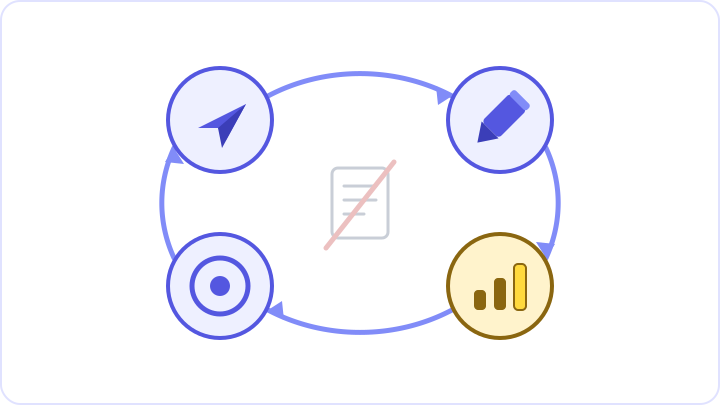
What to send instead of a PDF
You don't need to gamify your whole practice overnight. You need to swap the artifact for a loop. Whatever tool you use, hold it to five requirements:
| Requirement | Why it matters | The PDF fails because… |
|---|---|---|
| Opens in one tap | Every extra step cuts completion | Download → print/annotate → return |
| Corrects instantly | Errors must not be rehearsed | Wrong answers sit unchallenged |
| Short and spaced | 10–15 min, 2–3× a week beats one block | One long sheet invites cramming |
| Tied to your lesson | Practice should hit this week's gap | Generic units, generic errors |
| Records the attempt | You need results without collecting them | Whatever returns is unmarked paper |
In practice, that means building small interactive sets (multiple choice, fill-in-the-blank, true/false, match-the-pairs, sentence reconstruction) from the exact language of the lesson you just taught. If Tuesday's session was present perfect vs. past simple, Wednesday's ten minutes should be ten items on precisely that contrast, half of them using sentences your student almost said correctly. (Our Present Perfect guide lays out such a set as a four-module path.)
Need a text to start from? The free French reading list sorts public-domain French books from easier to harder, each with an excerpt you can turn into an exercise.
One nuance on exercise types: don't stop at recognition. Multiple choice and true/false are fast to answer (good for the mid-week set), but mix in production formats: reconstruct the sentence, complete the sentence, even pronunciation recordings the student can replay against a model. Recognition tells you they can spot the passé composé; production tells you they can build it. A good between-session week includes both.
Spaced repetition for language learning: three short sets, not one long one
Spaced repetition usually means a flashcard algorithm, but the principle underneath is older and simpler: the same practice, spread over several days, is remembered better than the same practice done in one sitting. It is the second technique Dunlosky and colleagues rated high-utility,2 and Cepeda and colleagues, pooling 317 experiments on verbal recall, found that the best gap between sessions grows with how long the material has to be kept.3
You don't need an algorithm to use it. You need the week to hold several small touches instead of one big one:
- Within an hour of the lesson: assign one short set on today's target (the language is still warm; setup takes minutes, not an evening).
- Mid-week: a second set mixing today's target with one older weak point. That's the spacing.
- Day before the next lesson: a five-minute warm-up set, so the student arrives activated instead of cold.
Three touches across the week, about thirty minutes in total, and nothing for you to mark. Each one is a retrieval with feedback, a few days after the last.
What about the students who genuinely like paper?
Some do, and two cases deserve an honest carve-out:
- Exam candidates. DELF and Cambridge writing papers are often still handwritten and time-boxed (Cambridge can also be taken on a computer). If your student is eight weeks from a handwritten exam, timed handwriting on real past papers is the practice, so don't digitise it. Digitise the drill layer underneath (verb forms, connectors, collocations) so lesson time can go to correcting the essays.
- Production work in general. A paragraph, a journal entry, a recorded monologue: those need a human reader, and reviewing them together in the lesson is money well spent. That was Off2Class's point about looking at work together,1 and for production it's right.
The rule that falls out: retrieval practice belongs in a feedback loop; production practice belongs in front of you. The mistake worth killing is only the middle case: auto-correctable drills travelling by PDF, where a machine could have done the marking and recorded the attempt.
How to see exactly where each student got stuck
Here's where the swap pays for itself. When practice happens in a tool that records attempts, the question "did you do the homework?" disappears, because you already know. But the interesting layer is one level deeper than done/not-done:
- Which items were missed. Not "unit 4 was hard" but "questions 3, 7 and 9, all of them irregular past participles."
- What they chose instead. The wrong answer is the diagnosis. A student picking have went has a different gap than one picking had gone.
- How many tries it took. Self-correcting on attempt two is a good sign; five attempts is a flag.
- How long they hesitated. Thirty seconds of silence before a correct answer means fragile knowledge that a right/wrong column would hide.
This is what we mean by per-exercise diagnostics, and it's the layer Teacher and Me was built around: you assign the set after the lesson, the student gets instant correction (plus the XP and streaks that keep them coming back), and you get the attempt-by-attempt picture before the next session starts. The guided tour of Teacher and Me shows each of those screens.
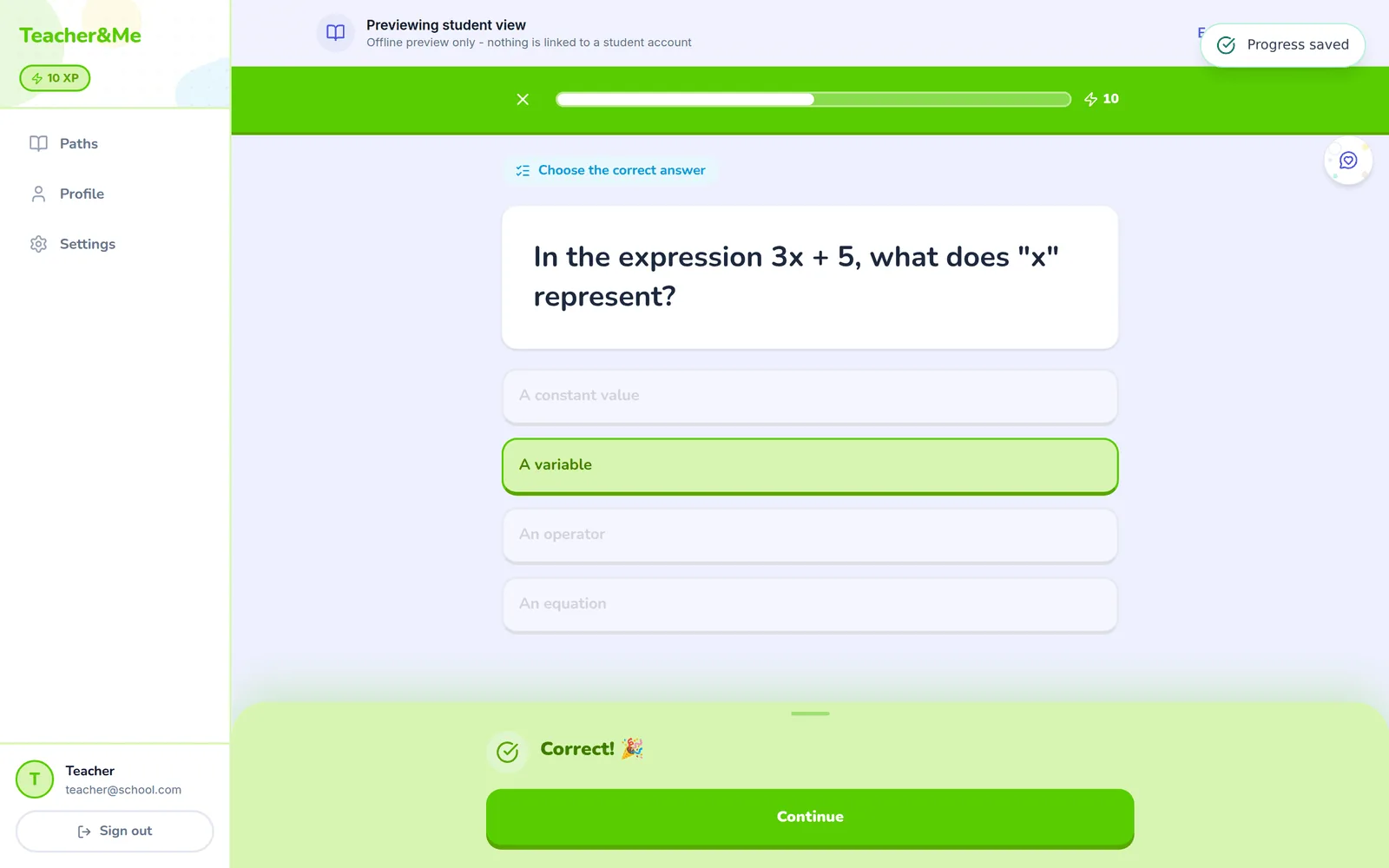
Your lesson prep then inverts. Instead of opening with re-diagnosis, you open with the answer: "You self-corrected every être-verb by Thursday, but descendre got you three times, so that's where we start today." Students notice that precision. It reads as professionalism, because it is. (It also gives you real material for progress reviews: see how to track student progress, which comes with a free tracker template.)
A one-week migration plan
You can leave the PDF ritual in seven days without rebuilding your teaching:
- Pick one student, ideally the one who never does the homework.
- After your next lesson, spend 15 minutes turning that lesson's target into one interactive set of 8–12 items.
- Assign it the same day with a one-line message: "10 minutes, by Thursday. I'll see the results, no need to send anything back."
- Check the results before the next session and open the lesson with one specific observation from the data.
- Repeat for two more weeks before judging. Habits, yours and theirs alike, take about three cycles.
The students who "never do homework" are usually the ones who respond fastest. Discipline was rarely the issue. They just needed to know that someone was actually going to look.
Sources
-
Off2Class, "How to assign homework for online lessons", reply by James Heywood (Off2Class) to a teacher's comment, 15 February 2015: https://www.off2class.com/assign-homework-for-online-lessons/ (as of October 2026). The full sentence: "My understanding is that the learning opportunity for the student happens when the teacher looks at the submitted work together with the student." ↩ back ↩ back
-
Dunlosky, J., Rawson, K. A., Marsh, E. J., Nathan, M. J., & Willingham, D. T. (2013). "Improving Students' Learning With Effective Learning Techniques." Psychological Science in the Public Interest, 14(1), 4–58. https://doi.org/10.1177/1529100612453266. Practice testing and distributed practice are the two techniques rated high-utility. ↩ back ↩ back
-
Cepeda, N. J., Pashler, H., Vul, E., Wixted, J. T., & Rohrer, D. (2006). "Distributed practice in verbal recall tasks: A review and quantitative synthesis." Psychological Bulletin, 132(3), 354–380. https://doi.org/10.1037/0033-2909.132.3.354. 839 assessments of distributed practice in 317 experiments; "the ISI producing maximal retention increased as retention interval increased." ↩ back ↩ back
-
Roediger, H. L., & Butler, A. C. (2011). "The critical role of retrieval practice in long-term retention." Trends in Cognitive Sciences, 15(1), 20–27. https://doi.org/10.1016/j.tics.2010.09.003. "Retrieval practice is often effective even without feedback … but feedback enhances the benefits of testing." ↩ back